Ambi, a committed artist
Ambi was born in 1978 in Antananarivo, the capital of Madagascar. Her full name is Ambinintsoa Andriankajarivelo; she came to France in 2000. She now lives and works between Marseille and Aix-en-Provence.
After a literary baccalauréat in Madagascar, she first studied architecture in Marseille, at Luminy, before taking a Master's degree in fine art at the Université de Provence in Aix-en-Provence.
She has exhibited regularly in France and abroad since 2005, with a particular loyalty to the Galerie Vincent Bercker in Aix-en-Provence. Close in spirit to arte povera, she finds her inspiration in humble materials and the everyday objects of Malagasy life, sharing Le Corbusier’s conviction that “great art lives on poor means.”
The studio, in motion
From her earliest years in Madagascar, the visual artist Ambi was deeply marked by the damage done by slash-and-burn farming and by deforestation. Faced with that fire-set violence, the young artist felt a keen sense of powerlessness.
Yet it is at the heart of that burning matter that her whole creative approach was found. Rather than submit to the destructive force of the flame, Ambi chose to explore what it can create, purify and make beautiful. Through work after captivating work, fire stops destroying and becomes a tool of transformation, able to build, to write and to transfigure.
Deeply committed to protecting the natural world, the artist turns her practice into a powerful means of ecological awareness. She invites everyone to tame fire with care and control, so that creation may prevail over annihilation. A true artistic signature, the incandescent element is today the thread running through her whole career and its central medium.
Ambi always works at night, alone, in silence. She composes her own mixtures of glue and solvents, then burns them with a blowtorch or, more simply, a lighter, right to the edge of control. The resulting pieces are assembled like a puzzle, deliberately made to come apart and back together: a work that is never quite fixed, one that anyone can recompose by hand.

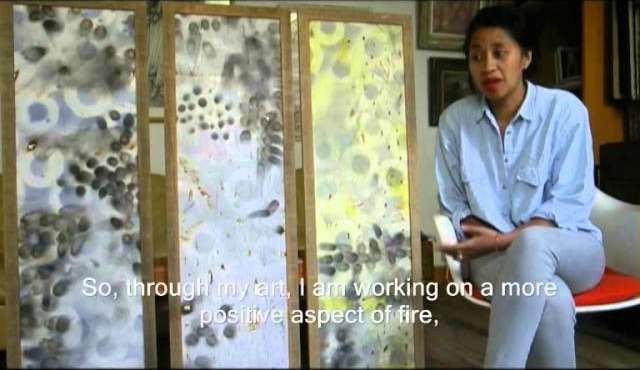
Ambi, Malagasy visual artist. Filmed portrait produced by Is'art Galerie, Antananarivo. Playing it loads YouTube.
What runs through the work
Fire
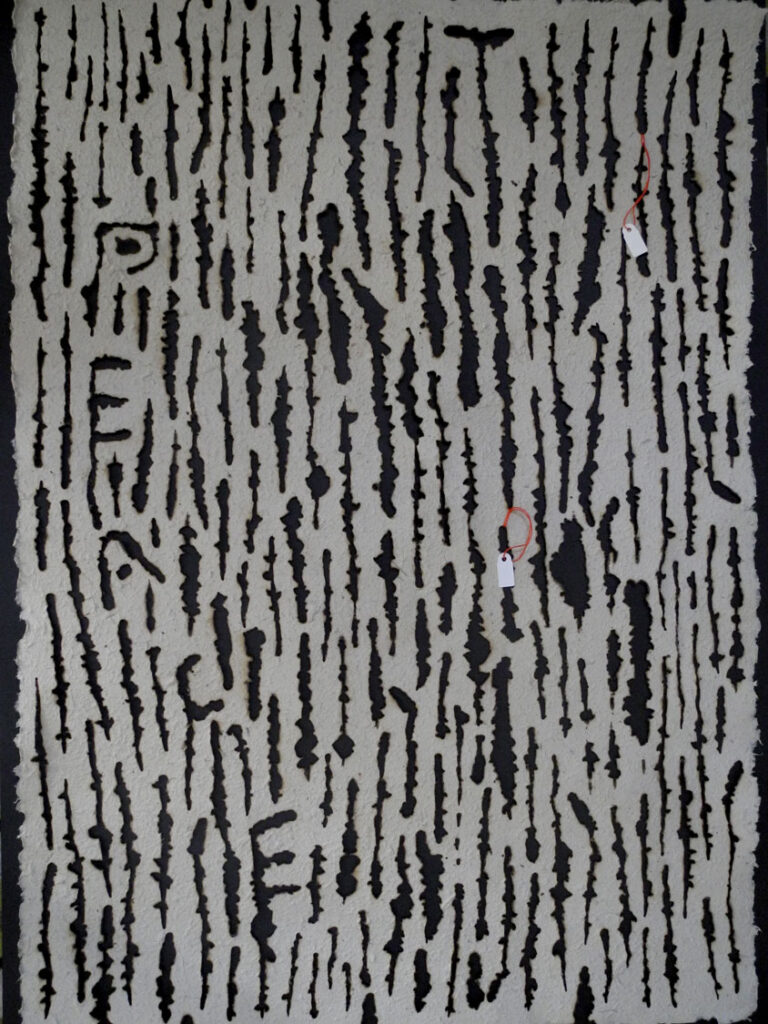
Fire becomes tool and material at once. Each burn is a controlled mark, laid on cloth or on paper: the trace of a gesture that builds where destruction was expected.
Identity
Who am I? Where do I come from? The question of identity holds a central place in Ambi's work. People are at the heart of her committed practice.
Antemoro paper
Made from the bark of the avoha, a tree that regenerates on its own, this Malagasy plant-fibre paper ties the work to the country's artisans and to the ecological balance of the forest.
Work made with others
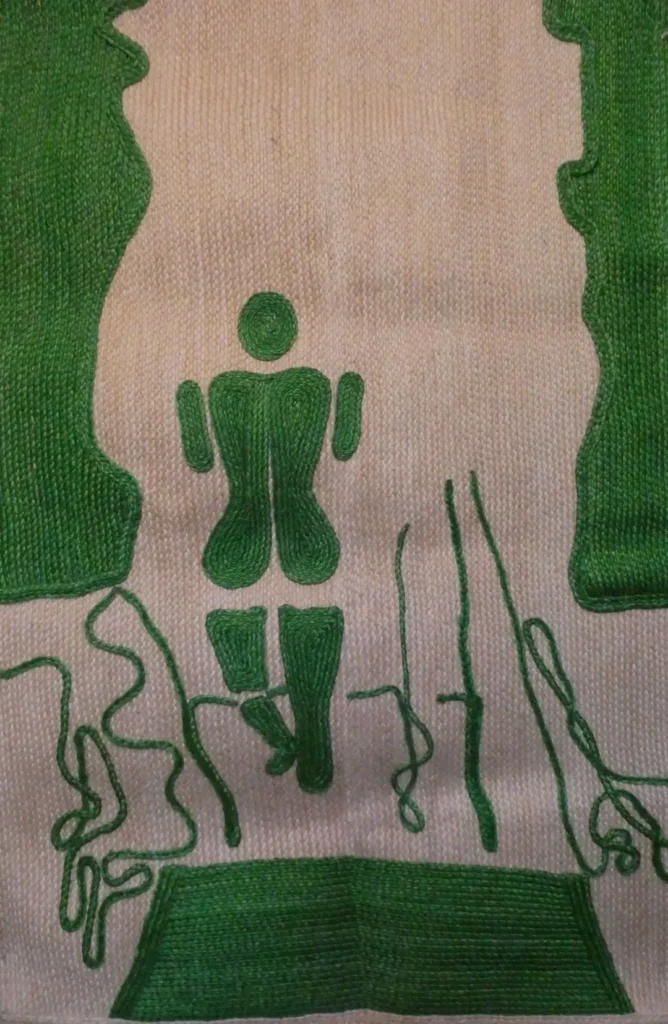
Several pieces come out of collective work: Rejet (New Shoot) was hand-woven with the Coopérative Kanto, a women's association from southern Madagascar; Naître et ne pas être was made with children in Madagascar, around human birth and the genotype.
This way of working extends what the works already question: what is passed on, what is transformed, what resists. A skill is handed down like a genetic heritage: through repetition, through variation, sometimes through accident. By entrusting part of the gesture to those who inherited it, the piece stops belonging to a single hand. It carries the memory of a place, of a community, and becomes the witness of a bond rather than a signature.
See the works